Falkland Islands (Five Species)
Part of our guide to the best places to see penguins in the wild — the Falklands rank #4 on the list.
Overview
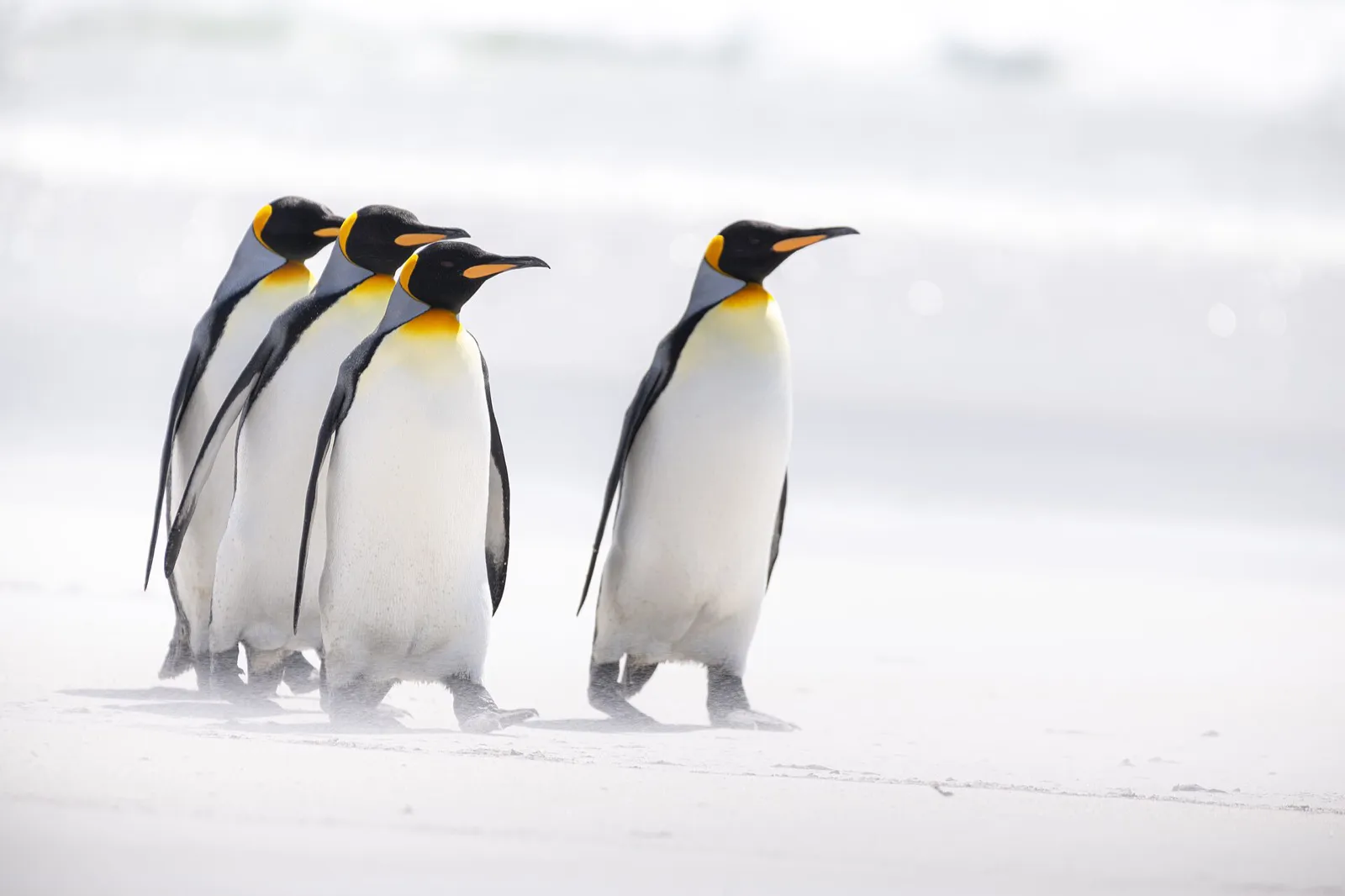
The Falkland Islands are the single best place on Earth for penguin variety: five species breed here — king, gentoo, southern rockhopper, Magellanic and macaroni — adding up to well over half a million breeding pairs across the archipelago. The headline act is Volunteer Point on East Falkland, home to roughly 1,500 breeding pairs of king penguins (almost the entire Falklands population of the species) on a sweeping white-sand beach, reachable as an off-road day trip from the capital, Stanley. Beyond that, the outer islands deliver the rest of the cast: rockhoppers bouncing up cliffs beside black-browed albatross colonies, gentoo "penguin highways", and burrow-nesting Magellanics — often with no other visitors in sight. Getting to the islands is the hard part: a weekly LATAM flight from Punta Arenas (Chile), a twice-weekly RAF Airbridge from England, or an expedition cruise between November and March. Once there, Stanley-area sites are easy day trips, while outer islands require FIGAS light-aircraft flights and lodge stays.
Location
- Where: A South Atlantic archipelago ~480 km (300 miles) east of the Patagonian coast of South America — approx. 51.7°S, 57.8°W (Stanley, the capital).
- The islands: Two main islands (East Falkland and West Falkland) plus hundreds of smaller islands — 778 in total by one widely used count. Most of the population lives in Stanley; the rest is "camp" — sparsely farmed sheep country.
- Status: A British Overseas Territory. Argentina also claims sovereignty, calling the islands the Islas Malvinas — a long-running dispute that led to the 1982 war and remains formally unresolved, though the islands are British-administered and English-speaking in daily life.
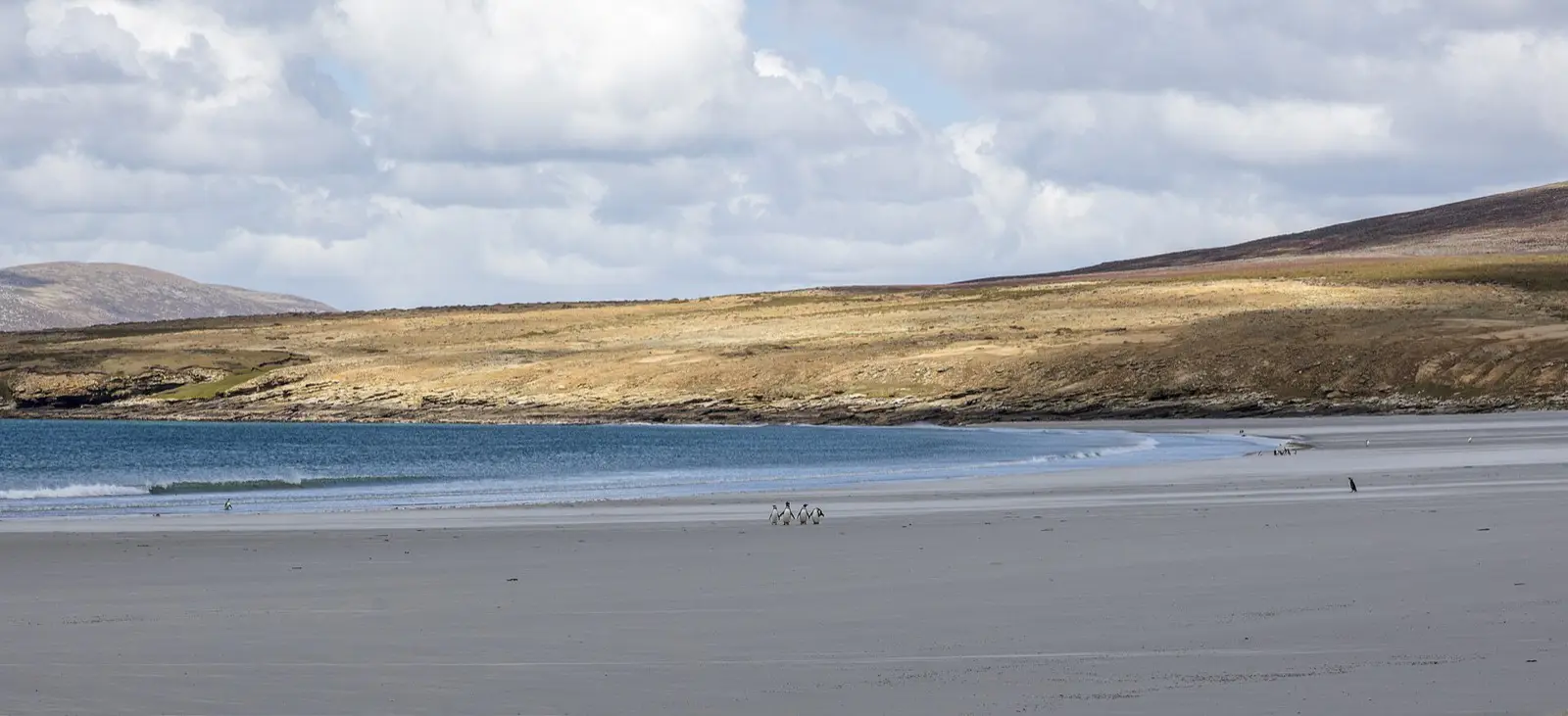
- Key sites: Volunteer Point (kings, ~75 km from Stanley); Gypsy Cove and Yorke Bay (Magellanics, 8.5 km from central Stanley); Saunders Island and its Neck (four penguin species plus albatross); West Point Island (rockhoppers with black-browed albatross); Sea Lion Island, Bleaker Island and Carcass Island (multi-species lodge islands); Cape Bougainville and Kidney Island off East Falkland's north coast.
- Access pattern: Stanley-area sites (Gypsy Cove, Volunteer Point, Bertha's Beach, the Murrell) are day-trip-able by road or 4WD. Outer islands have no roads or ferries for tourists — access is by FIGAS light aircraft with stays at small island lodges, or via expedition cruise landings.
Penguin Species
King penguin (Aptenodytes patagonicus) — the star of Volunteer Point and the largest of the Falkland penguins (78–90 cm tall, 12–15 kg). The Falklands are at the northern edge of its global range.
- Population: Around 1,500 breeding pairs in the Falklands, almost entirely concentrated at Volunteer Point — a tiny fraction of the world population of ~1.7 million pairs (IUCN Least Concern). Some 500–700 chicks are produced each year; the 14-month breeding cycle (the longest of any penguin, allowing only two chicks every three years) means downy brown chicks are present at Volunteer Point year-round.
- Also at Volunteer Point: Roughly 3,600 pairs of gentoos and 2,500 pairs of Magellanic penguins nest at the same site — three species in one stop.
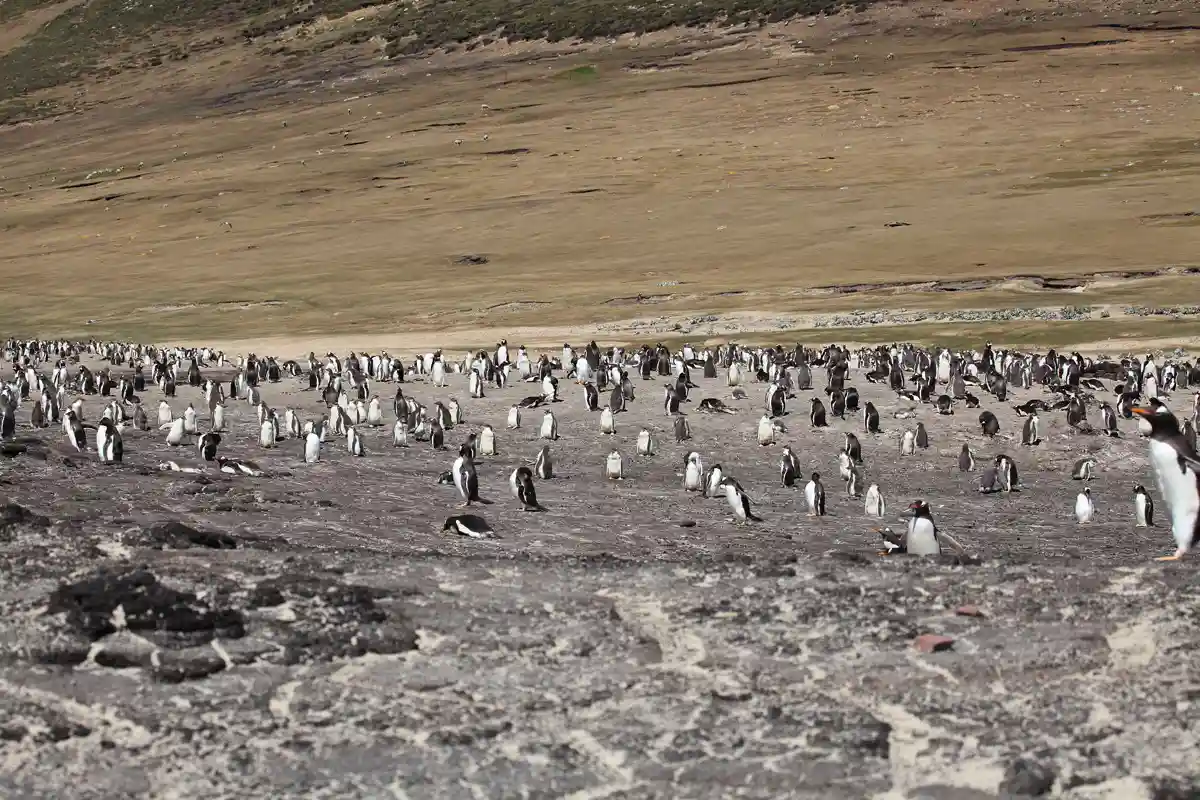
Gentoo penguin (Pygoscelis papua) — white head-band, orange bill and feet; the second-largest Falkland penguin and the most widespread around the coast.
- Population: The 2010 archipelago-wide census counted about 132,000 breeding pairs across ~85 colonies — the largest gentoo population in the world, roughly a third (34%) of the global total. Numbers fluctuate but have averaged around 100,000 pairs over 75 years; globally stable and IUCN Least Concern.
- Behaviour: Resident year-round; colonies up to 5 km inland are reached by worn "penguin highways", busiest in the early evening rush hour as birds return from the sea.
Southern rockhopper penguin (Eudyptes chrysocome) — the punk-crested cliff-climber, smallest of the Falklands' penguins at ~50 cm.
- Population: The 2010 census estimated 319,000 ± 18,500 breeding pairs at around 35 colonies — about 36% of the world population of this subspecies. IUCN Vulnerable after long-term declines, though the Falklands population appears stable.
- Where: West Point Island (nesting among ~2,000 pairs of black-browed albatross), Saunders Island's Rookery (famous for its natural cliff "shower"), New Island, and day-trip sites on the Murrell peninsula near Stanley. Present September to April.
Magellanic penguin (Spheniscus magellanicus) — the braying "jackass" penguin, and the only Falklands species that nests in burrows dug up to 2 m into the peat.
- Population: Around 100,000 breeding pairs by recent (2019/20) estimates — down roughly 90% since the end of the 1980s, a decline linked to commercial fishing pressure; the species has fared far better in protected colonies in Argentina and Chile.
- Where: Gypsy Cove and Yorke Bay (the easiest penguin viewing of all, 8.5 km from Stanley), Carcass Island, Bleaker Island and Volunteer Point. Present September to late April.
Macaroni penguin (Eudyptes chrysolophus) — the rarity: only a few dozen pairs (~50) breed in the Falklands, mostly on Kidney Island, making this by far the smallest penguin population in the islands.
- Bonus seabird: The Falklands hold about 70% of the world's black-browed albatross (~400,000 breeding pairs) — you will see them at the same colonies as the rockhoppers.
Getting There & Difficulty
- LATAM via Chile (the standard route): One flight per week, Saturdays only, Santiago–Punta Arenas–Mount Pleasant (MPN); once a month it also stops in Río Gallegos, Argentina (outbound on the second Saturday, returning via there on the third). Fares run about US$500 return from Santiago, and the weekly rhythm forces stays in multiples of one week. Seats sell out weeks to months ahead in season.
- RAF Airbridge via the UK: Twice-weekly MoD-chartered flights (operated by AirTanker) from RAF Brize Norton, Oxfordshire, ~18 hours with a ~2-hour refuelling stop on Ascension Island. Around £2,200 return for civilians; booking is old-school — by phone/email through the Falkland Islands Government Office in London (travel@falklands.gov.fk), paid by bank transfer, with only limited civilian seats and military-priority schedule changes. Don't plan tight connections.
- Expedition cruises: The other common way in — Antarctic-season voyages (November–March) from Ushuaia or Punta Arenas typically spend 1–3 days in the Falklands, often combined with South Georgia, landing at outer-island sites that are hard to reach independently.
- On the islands — FIGAS: The government air service flies five Britten-Norman Islanders like an air taxi to ~35 grass and gravel strips. There is no timetable: book by 10 am the day before (usually via your lodge), and the next day's schedule is published that afternoon on local radio and Facebook. Fares are distance-based — about £70 one way for shorter hops; luggage is capped at 14 kg. Weather (especially fog) can cancel a whole day.
- Volunteer Point day tours: About 2–2.5 hours each way from Stanley, the last stretch over trackless peat farm country — a local 4WD guide is effectively required. Full-day tours (6–7 hours) run roughly US$320–440 per person, or about £680–740 per vehicle with private operators; visitor numbers at the site are capped, and the track closes after heavy rain.
- Difficulty: Moderate to hard overall. Stanley itself is easy; Volunteer Point is a long, bumpy but non-technical day out; the outer islands demand flexible schedules, light luggage and tolerance for weather delays.
- Booking: Book flights months ahead for the November–February peak; FIGAS and outer-island lodges are best arranged together, well in advance.
Best Time to Visit
- October–March: The main season, when outer-island lodges are open and all five penguin species are ashore. Most visitors come November–February.
- September–October: Rockhoppers and Magellanics return to their colonies (both are present September–April); gentoos are nest-building, with eggs laid in October.
- November–February: Peak spectacle — gentoo chicks (fledging by late February), rockhopper and Magellanic chicks, and maximum penguin traffic between colonies and the sea. Long daylight hours.
- January–March: Recommended window for Volunteer Point — king parents shuttle food to chicks before they join the crèche; the beach is at its busiest.
- Year-round: King penguin chicks are present at Volunteer Point in every month thanks to the 14-month cycle, and gentoos are resident all year — but winter (April–September) is cold, many lodges close, and rockhoppers and Magellanics are at sea.
- Weather: Cool, windy and changeable in any season. Summer days are typically 5–15°C (occasionally warmer), winter 1–5°C, and the wind is constant — pack windproof and waterproof layers even in midsummer.
Tips
- Prioritise Volunteer Point. It is the one must-do: the largest king penguin colony in the Falklands, plus gentoo and Magellanic colonies, on a 3.2 km white-sand beach. Book a 4WD tour the moment your flights are confirmed — the site caps visitor numbers.
- Add at least one outer island if you can. Saunders Island's Neck packs four penguin species and an albatross colony into one spot; West Point pairs rockhoppers with ~2,000 pairs of black-browed albatross; Sea Lion Island can deliver all five penguin species (macaronis included) plus elephant seals. Lodges are small and book out far ahead.
- Follow the Countryside Code. Keep at least 6 m (20 ft) from all wildlife, never get between an animal and the sea, and don't feed or chase anything. Volunteer Point has wardens to enforce the rules — sit still and curious penguins may well approach you instead.
- Photography is welcomed. Bring a zoom lens and a weather-sealed bag for the bumpy off-road legs; no special permits are needed for personal photography, just the distance rules.
- Gypsy Cove and Yorke Bay are the easy win. Magellanic penguins 8.5 km from Stanley by taxi or tour — and a piece of history: these beaches were mined in 1982, and the penguins (too light to trigger mines) had them to themselves for 38 years. The islands were officially declared mine-free on 14 November 2020 after a £44m UK-funded clearance programme, and the beaches have since reopened.
- Build in slack. FIGAS schedules are set the afternoon before and fog can ground planes; international flights run at most weekly. Never schedule an outer-island return the same day as your flight out.
- Money and packing: The Falkland Islands pound is pegged one-to-one with the UK pound, which is accepted everywhere; carry some cash outside Stanley, where card machines are not guaranteed. Bring sunscreen — the high-latitude sun burns fast — and enough prescription medicine for delays.
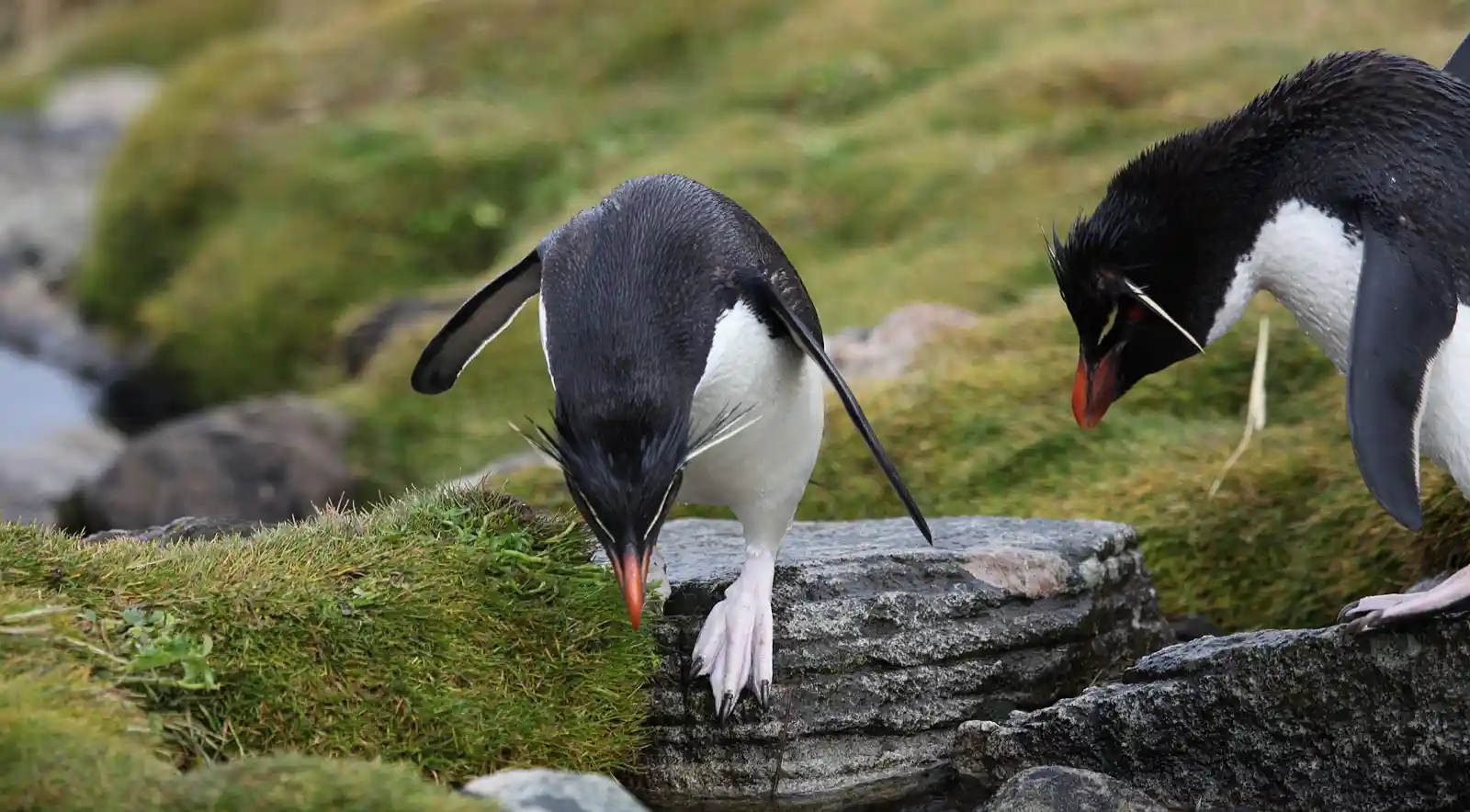
Image Credits
All photos are real, freely licensed images from Wikimedia Commons — authors and licenses are credited in the captions. All four photographs were taken in the Falkland Islands at the locations named in their captions.
Sources
- Falklands Conservation — King penguin species page (1,500 pairs concentrated at Volunteer Point, 500–700 chicks/year, 14-month cycle, world population 1.7M pairs, diving/feeding notes): falklandsconservation.com
- Falklands Conservation — Gentoo penguin species page (~85 colonies, 2010 census figure, largest world population, ~100,000-pair long-term average, penguin highways, IUCN Least Concern): falklandsconservation.com
- Falklands Conservation — 2010 Archipelago-wide Census report, Baylis 2012 (gentoo 132,321 pairs; rockhopper 319,163 ± 18,503 pairs, ~36% of world subspecies population; 70% of world black-browed albatross): falklandsconservation.com
- Falklands Conservation — Seabird Monitoring Programme Annual Report 2016/17 (34% of world gentoo, 72% of world black-browed albatross, Magellanic estimate 76,000–142,000 pairs): falklandsconservation.com
- Nature Scientific Reports (2025) — Status and global population trend of the Magellanic penguin (Falklands decline from ~1989/90 to ~100,000 pairs in 2019/20): www.nature.com
- penguins.cl — Penguins of the Falkland Islands (five breeding species incl. ~50 macaroni pairs): penguins.cl
- Antarctica21 — Meet the penguins (rockhopper ~50 cm, 35 colonies incl. Steeple Jason, Sep–Apr presence, Vulnerable; Magellanic burrows up to 2 m, ~100,000 pairs): www.antarctica21.com
- Falkland Islands Tourist Board — Volunteer Point, the Penguin Paradise (1,500 king pairs, crèche behaviour, 6 m/20 ft rule, wardens, Jan–Mar window, off-road access): www.falklandislands.com
- Falkland Islands Tourist Board — Visitor FAQs (Gypsy Cove 8.5 km from Stanley, Volunteer Point 2.5-hour drive with guide, mine-free November 2020, Countryside Code 6 m rule, Falkland pound at par with GBP): falklandislands.com
- International Parks — Volunteer Point (1,500 king / 3,600 gentoo / 2,500 Magellanic pairs, 75 km from Stanley, 3.2 km Volunteer Beach, National Nature Reserve 1968, Important Bird Area, Johnson's Harbour Farm): www.internationalparks.org
- The Falklander — How to get here (LATAM Saturday-only schedule, monthly Río Gallegos stops, AirTanker twice-weekly Airbridge via Ascension, booking via FIGO London, Mount Pleasant 56 km from Stanley): www.thefalklander.com
- Against the Compass — Falklands travel guide, 2026 (Spanish; LATAM ~US$500 return and week-multiple stays, RAF Airbridge £2,200 return, travel@falklands.gov.fk booking, check-in quirks): againstthecompass.com
- Big World Small Pockets — Falkland Islands flights guide (FIGAS five BN-2B Islanders, air-taxi model, ~£70 one way, 14 kg luggage cap, next-day schedule by radio/Facebook): www.bigworldsmallpockets.com
- Cicerone — Island hopping on the Falkland Islands (778 islands, FIGAS booking cut-off and scheduling, October–March season with most visitors November–February): www.cicerone.co.uk
- Swoop Antarctica — 10 best places in the Falklands & Saunders Island guide (four penguin species at The Neck, West Point ~2,000 albatross pairs, Carcass rat-free with Cobb's wren, Bleaker's three species): www.swoop-antarctica.com and www.swoop-antarctica.com
- Falkland Islands Holidays — Saunders Island (Rookery rockhopper "shower", first British settlement 1765 at Port Egmont, accommodation options): www.falklandislandsholidays.com?p=160
- MercoPress — Falkland Islands celebrate becoming mine-free, 14 November 2020 (£44m programme begun 2009, Gypsy Cove/Yorke Bay final beaches cleared): en.mercopress.com
- Tripadvisor / Viator tour listings — Volunteer Point 4WD day tours (6–7 hours, from ~US$319–437 per adult) and Lupin Tours (per-vehicle pricing £680–740, visitor limits at Volunteer Point): www.tripadvisor.com and www.lupin.tours
Related destinations
- South Georgia — usually combined with the Falklands on the same expedition cruise.
- Punta Tombo — the biggest Magellanic colonies are in mainland Patagonia.