Punta Tombo
Part of our guide to the best places to see penguins in the wild — Punta Tombo ranks #8 on the list.
Overview
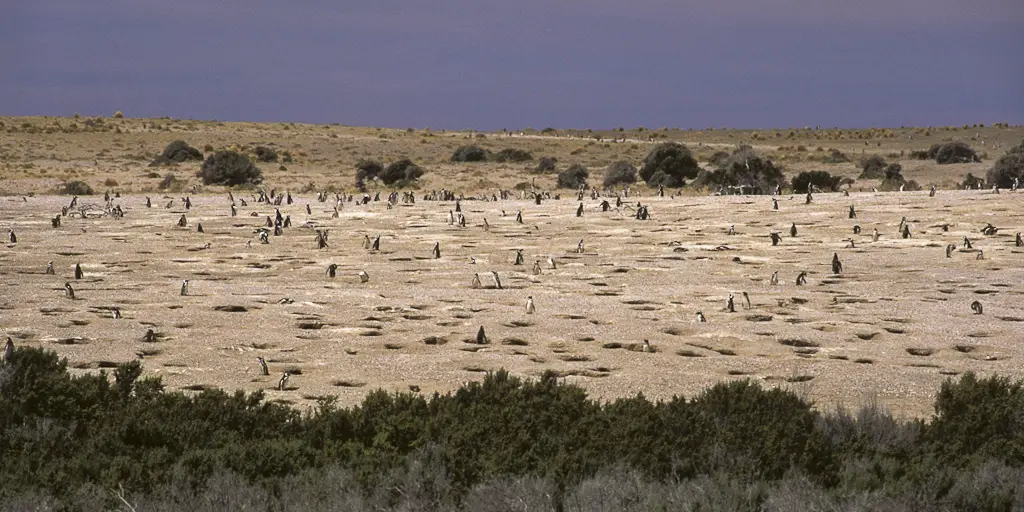
Punta Tombo is the classic South American penguin experience: a narrow gravel peninsula on the Patagonian coast of Chubut Province, Argentina, where around 200,000 breeding pairs of Magellanic penguins nest in burrows and under bushes between September and April. At the peak of the season, with adults, chicks and non-breeding juveniles ashore together, the colony can hold over a million individual birds — the largest continental Magellanic penguin colony in the world. Visitors walk marked trails straight through the nesting area, with penguins crossing the path at arm's length. The reserve sits about 110 km south of Trelew (roughly two hours by car) and 180–190 km from Puerto Madryn (about 2.5–3 hours), and is reached by rental car or organized day tour — there is no public transport. A modern interpretation centre (the Tombo Centre) handles ticketing and regulates visitor flow before a shuttle bus takes you to the trailhead.
Location
- Where: Área Natural Protegida Punta Tombo (Punta Tombo Protected Natural Area), Atlantic coast of Chubut Province, Patagonia, Argentina — approx. 44.0°S, 65.2°W.
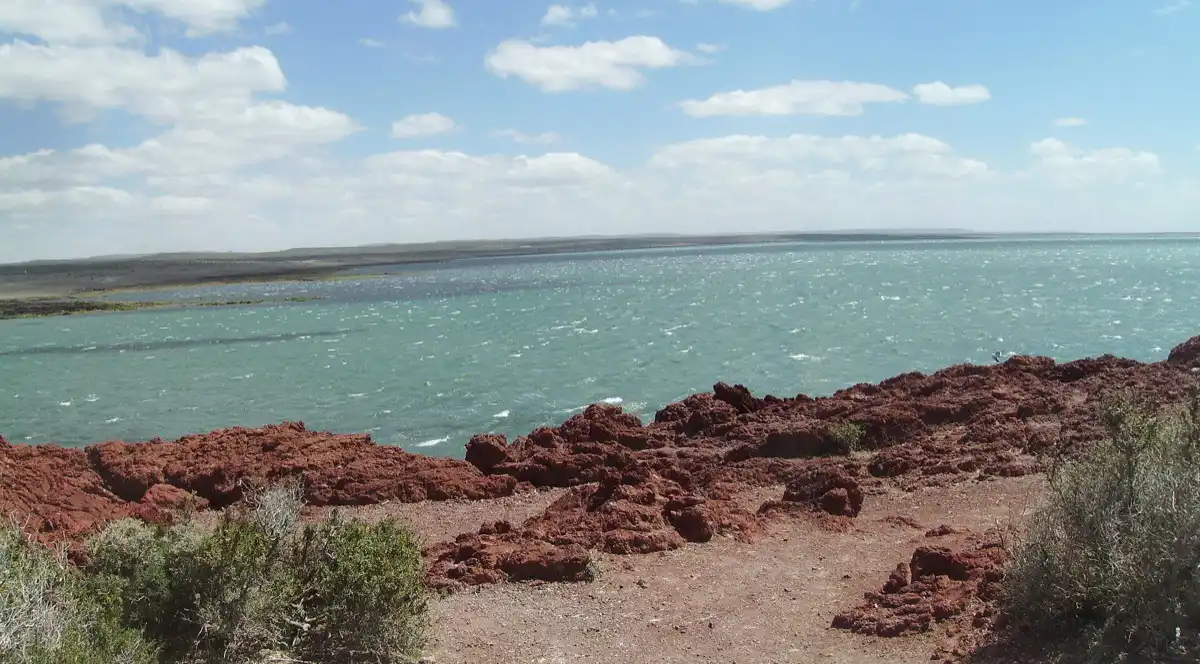
- The peninsula: A narrow, rocky strip of sedimentary rock and gravel that extends about 3.5 km into the South Atlantic, with gently sloping beaches where penguins come ashore. The protected area covers roughly 2,100–3,000 hectares of coastal steppe and shoreline (figures vary by source and by whether adjacent marine sectors are counted).
- Distance: ~110 km south of Trelew (about 2 hours' drive); ~180–190 km south of Puerto Madryn (about 2.5–3 hours). The nearest airport is Trelew (REL).
- The site: Parking area and entrance-fee booth, the Tombo Centre interpretation centre with exhibition halls, café/restaurant, gift shop and toilets, then a shuttle bus to the start of the walking trails through the colony.
- Status: Part of Chubut's provincial system of Protected Natural Areas; protected since 1979 (formally designated a Tourist Nature Reserve in 1983 and reclassified as a Provincial Park in 2007). It lies within the Patagonia Azul UNESCO Biosphere Reserve (approved 2015). Admission is ticketed and the fee funds conservation.
Penguin Species
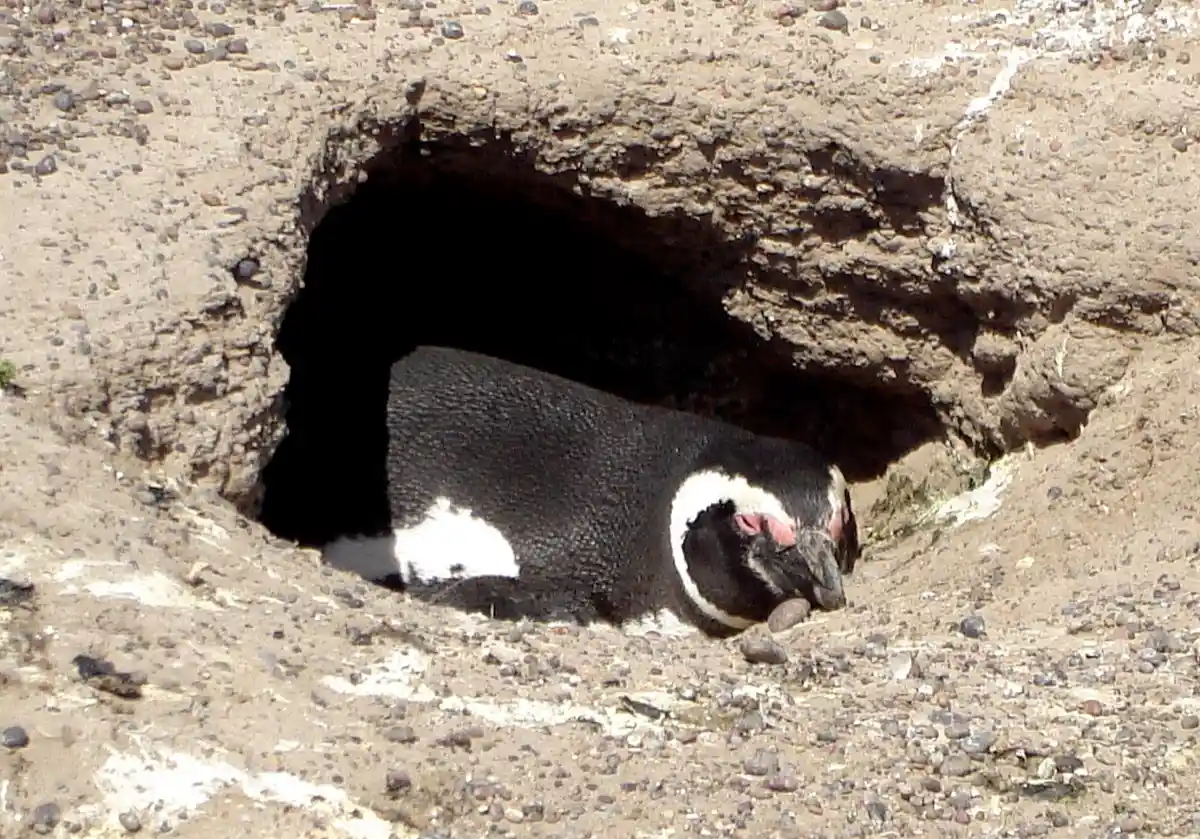
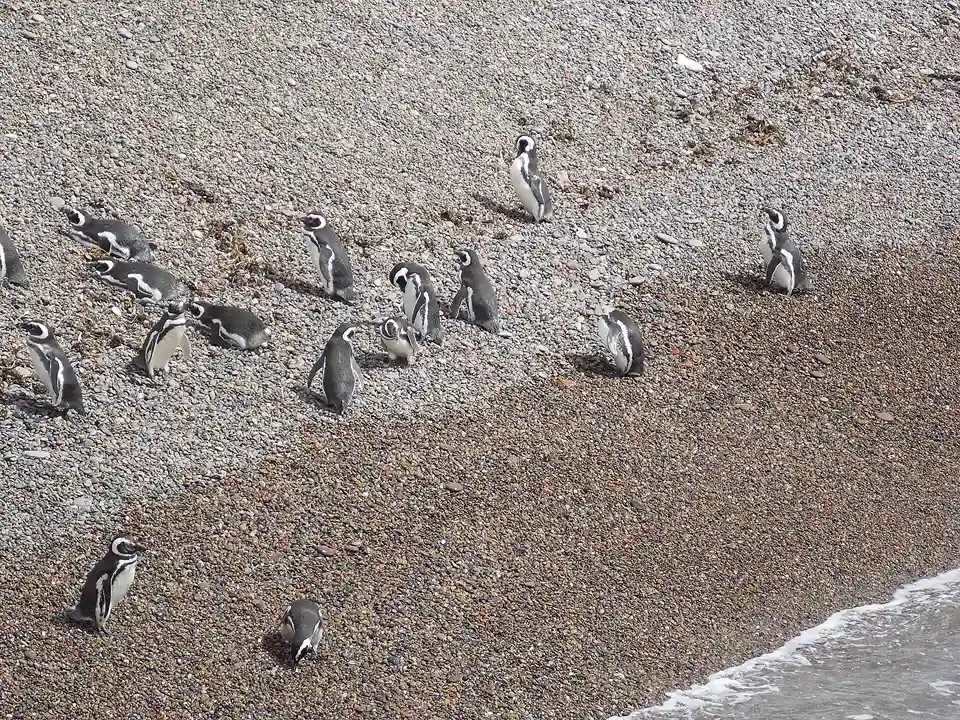
Magellanic penguin (Spheniscus magellanicus) — the only species here. A medium-sized banded penguin, 61–76 cm tall and 2.7–6.5 kg, with two black bands across the chest and a pink patch of bare skin around the eye. It is the most numerous of the Spheniscus penguins and was named after Ferdinand Magellan, whose crew recorded the species in 1520.
- Colony size: Around 200,000 breeding pairs in recent years — widely cited as the largest continental Magellanic penguin colony in the world (larger colonies of the species exist only on islands, e.g. in the Falklands/Malvinas). The famous "over a million penguins" figure refers to peak-season totals of adults, chicks and juveniles combined, not to breeding pairs.
- A colony in decline: University of Washington researchers (Dee Boersma's team), who have studied the colony continuously since 1982, counted about 400,000 breeding pairs in the early 1980s but only ~150,000 by 2019 — a decline of more than 40% since 1987. A 2022 PNAS study linked the decline to climate "presses and pulses": heat waves (one single-day heat wave in 2019 killed more than 350 penguins), increased rainfall that chills chicks, and shifting food supplies. Many birds are abandoning Tombo for newer colonies farther north, closer to their prey.
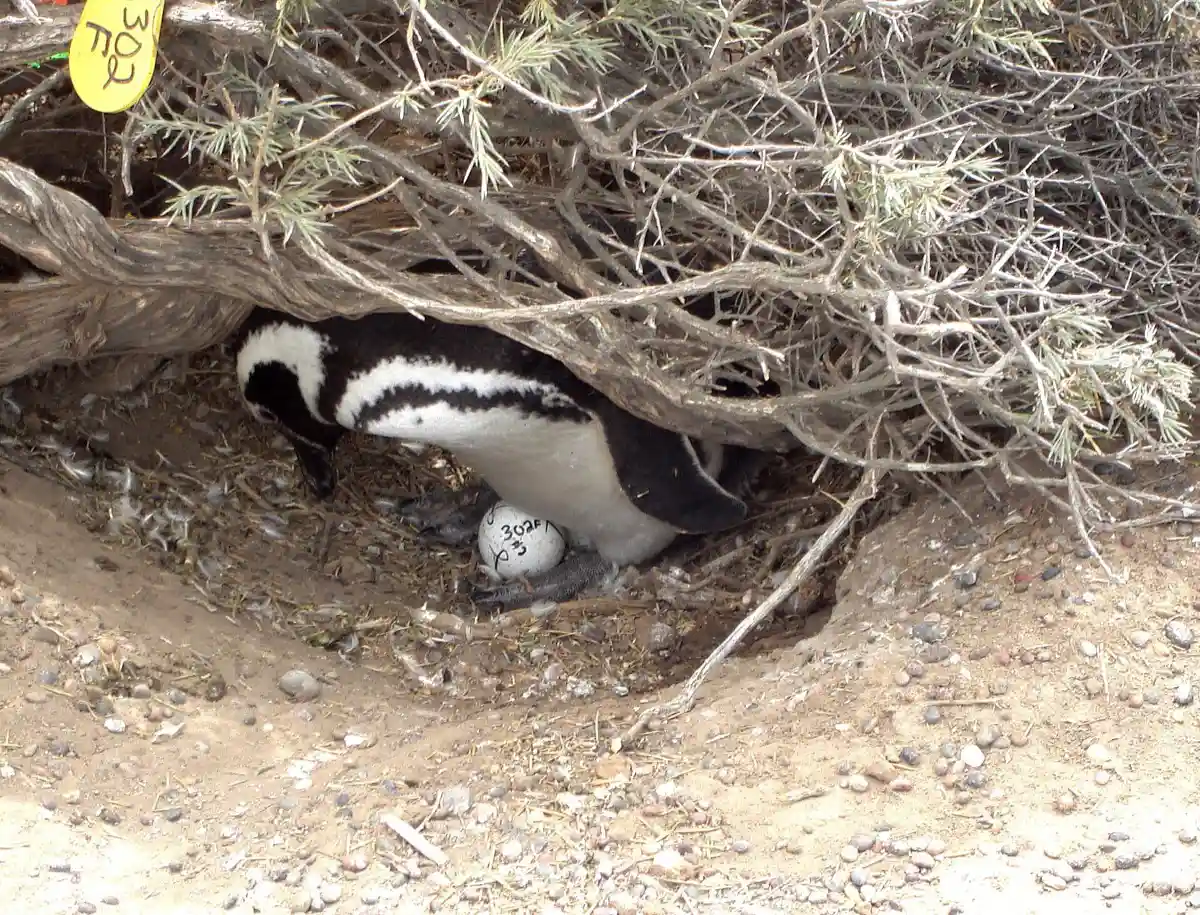
- Nesting: Penguins nest in burrows dug into the gravelly soil or under the cover of low bushes — the trails pass within a metre or two of occupied nests. Two eggs are laid (mainly October), incubation takes about 40–42 days, and both parents share incubation and chick-rearing.
- Conservation status: IUCN Red List — Least Concern, but with a decreasing population trend; the global population is estimated at roughly 1.1–1.6 million breeding pairs (2.2–3.2 million mature individuals). The species is migratory, wintering at sea off northern Argentina, Uruguay and southern Brazil.
Getting There & Difficulty
- Rental car (most flexible): From Trelew take National Route 3 south, then Provincial Route 75 (recently paved), then Provincial Route 1; the final ~20–25 km to the reserve are gravel. Allow about 2 hours from Trelew and 2.5–3 hours from Puerto Madryn. Keep speeds down on the gravel (locals advise 40–50 km/h).
- Fuel: fill up in Trelew or Puerto Madryn. There are no petrol stations on the route or at the reserve.
- Organized day tours: Numerous agencies in Puerto Madryn and Trelew run full-day tours (typical price around US$100–130 per person, usually excluding the entrance fee), commonly combining Punta Tombo with the Welsh village of Gaiman for afternoon tea, and sometimes the Trelew Paleontological Museum. Boat trips to see Commerson's dolphins from Puerto Rawson/Playa Unión are another frequent add-on, and many visitors pair Tombo with a separate day at Peninsula Valdés.
- Public transport: none. There is no bus service to the reserve.
- Difficulty: Easy to moderate. From the Tombo Centre a shuttle bus takes visitors to the trailhead. Two marked walking routes run through the colony: a short path of about 650 m and a long path of about 3.5 km, mostly flat gravel with boardwalks and footbridges over the busiest penguin crossings. Allow 2–3 hours on site.
- Cost: The foreign-visitor entrance fee was AR$25,000 per adult (about US$18) with a concession rate of AR$15,000, children 5 and under free (as reported for the 2025–26 season; older sources list AR$8,500 — Argentine inflation means prices change frequently, so check current rates before you go). Bring cash, as cards may not be accepted.
- Opening hours: Daily during the season (September–April). Most sources give 9:00–17:00; some list 8:00–18:00 in high season — confirm locally. The reserve is closed outside the penguin season.
Best Time to Visit
- Season: September to April — the reserve opens when the penguins come ashore and closes after they leave for their wintering grounds off Brazil and Uruguay.
- September–October: Males arrive first in September and claim nest sites; females follow about a week later. Nests are built and eggs laid — huge numbers of birds, lots of courtship and territorial squabbling.
- November–December: Chicks hatch from mid-November; both parents commute to the sea for food. Often cited as the peak spectacle, when the colony's total population (adults + chicks + juveniles) can exceed one million birds.
- January–February: Chicks grow, moult into juvenile plumage and take their first swims; the warmest (and windiest) months, with the biggest visitor crowds.
- March–April: Adults and juveniles moult and depart; numbers thin out fast, and by April the peninsula is nearly empty.
- Weather note: This is the open Patagonian steppe — strong winds are the norm, there is virtually no shade, and summer temperatures can exceed 30°C (occasionally approaching 40°C). Visit early in the morning for smaller crowds, cooler air and more penguin activity on the move between nests and sea.
Tips
- Penguins have right of way. Birds constantly cross the path on their way to and from the sea; stop, step aside and wait. Rangers are stationed along the trail to enforce the rules.
- Stay on the marked trails at all times — burrows collapse easily underfoot, and nests are everywhere, including centimetres from the path edge.
- Do not touch, feed or crowd the penguins, and avoid flash photography; don't poke lenses into their faces — they can and do peck.
- Photography is allowed and encouraged (unlike some penguin sites) — bring a zoom or just patience, since the birds come to you.
- Dress for wind and sun, not for cold alone: windproof layer, hat, sunglasses, sunscreen, and carry water — there is no shade and no drinking water out on the trails.
- Buy your ticket and walk through the Tombo Centre first — the exhibits (mostly in Spanish) explain the colony's lifecycle and research; the shuttle to the trails runs from there.
- Bring cash for the entrance fee, and don't rely on mobile signal at the reserve.
- Fill the tank before leaving Trelew or Puerto Madryn, and consider driving in the afternoon when tour buses have left (the reserve is open until 17:00–18:00 depending on season).
- Make a day of it: pair the reserve with Welsh tea in Gaiman, a Commerson's dolphin boat trip from Puerto Rawson, or the Trelew Paleontological Museum; Peninsula Valdés (southern right whales, sea lions, elephant seals) deserves a separate day.
- Other wildlife on site: guanacos, greater rheas (ñandúes), Patagonian maras, grey foxes, armadillos and cuis on the steppe; kelp gulls, dolphin gulls, imperial and rock shags along the shore, with South American sea lions and occasional whales and orcas offshore.
Image Credits
All photos are real, freely licensed images from Wikimedia Commons, all taken on site at Punta Tombo — authors and licenses are credited in the captions.
Sources
- Punta Tombo Protected Natural Area (official site, Chubut) — trails (650 m short / 3.5 km long), shuttle system, Tombo Centre, visitor rules: www.pinguinosentombo.com.ar
- AMP Argentina (Federal protected-areas agency) — ~200,000 breeding pairs, largest known colony, marked population decrease, 1983/2007 designations, Patagonia Azul Biosphere Reserve, wildlife lists: ampargentina.org
- University of Washington / Newswise — PNAS study: breeding pairs fell from ~400,000 (early 1980s) to ~150,000 (2019), climate presses and pulses, 2019 heat wave: www.newswise.com
- University of Washington Biology — population decline of more than 40% since 1987, skewed sex ratio, colony studied since 1982: www.biology.washington.edu
- BirdLife International Data Zone — IUCN status Least Concern, decreasing trend: datazone.birdlife.org
- Time Travel Turtle (updated 2026) — foreign entrance fee AR$25,000 / concession AR$15,000, hours 9:00–17:00, distances, no public transport: www.timetravelturtle.com
- Peninsula Valdés travel guide — distances (180 km Puerto Madryn / 110 km Trelew), last 25 km gravel, tour price ~US$130, monthly wildlife calendar, hours 8:00–18:00: peninsulavaldes.com
- Patagonia Penguins (firsthand account) — route via Ruta 3/75/1, gravel final 20 km, no fuel south of Trelew, ~1 km core path, ranger instructions: www.patagoniapenguins.org
- Xinhua feature (2019) — ranger-quoted ~250,000 couples, September–April season, males arrive a week before females, chicks from mid-November, other wildlife: www.xinhuanet.com
- SeaWorld animal facts — size 61–71 cm, ~5 kg, incubation 40–42 days, 2 eggs, global population 1.1–1.6 million pairs: seaworld.org
Related destinations
- Isla Magdalena (Chile) — another easy Magellanic colony, from Punta Arenas.
- Martillo Island (Ushuaia) — gentoo and Magellanic penguins in Tierra del Fuego.